Tour
One week at Cedar & Co.
Cedar & Co. is the company in Harbor’s live demo. This is what its week looks like from the inside, with the real screens. Everything here is in the demo, open with no account.
The company
Eight people, three portfolios
Cedar & Co. makes trail shoes, packs and an app for people who use them. Mara Chen, the director of product, runs the year from Harbor. Seven others work with her: an engineering lead in Brooklyn, a designer in Oakland, a program manager in Austin, brand in Berlin, operations in Kyoto, an engineer in Denver and a researcher in Santa Fe.
The year is three portfolios. Summit Line is the new trail collection ($1.2M). Digital Habitat is the member app and the online store ($890k). Campfire Retail is the fall campaign and a pop-up shop in Portland ($540k). Under them sit five programs, each with an owner and an end date, and ten projects on boards.
The demo’s dates move with today’s, so whenever you open it, it is this week at Cedar.
Monday
The portfolio review
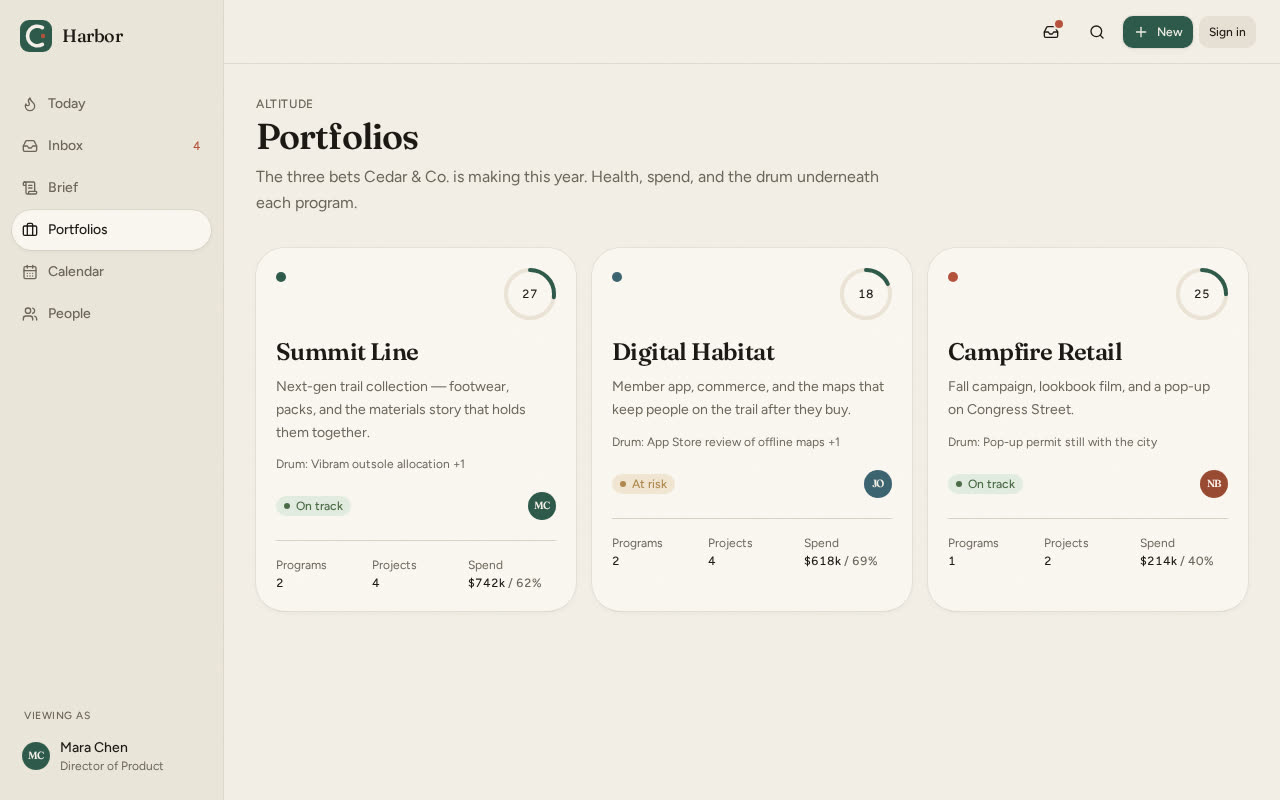
Mara starts the week on the portfolio view instead of a slide deck. Each portfolio shows its health, how much of its budget is spent and how far along the work is. Health isn’t typed in by whoever is most optimistic; Harbor works it out from late tasks, end dates, blocked work and crowded boards. Anyone who disagrees can override it, but the override has to carry a note.
Digital Habitat is the one to talk about. Its program description says it plainly: “The map work is the risk.”
A program
A supplier slips two weeks
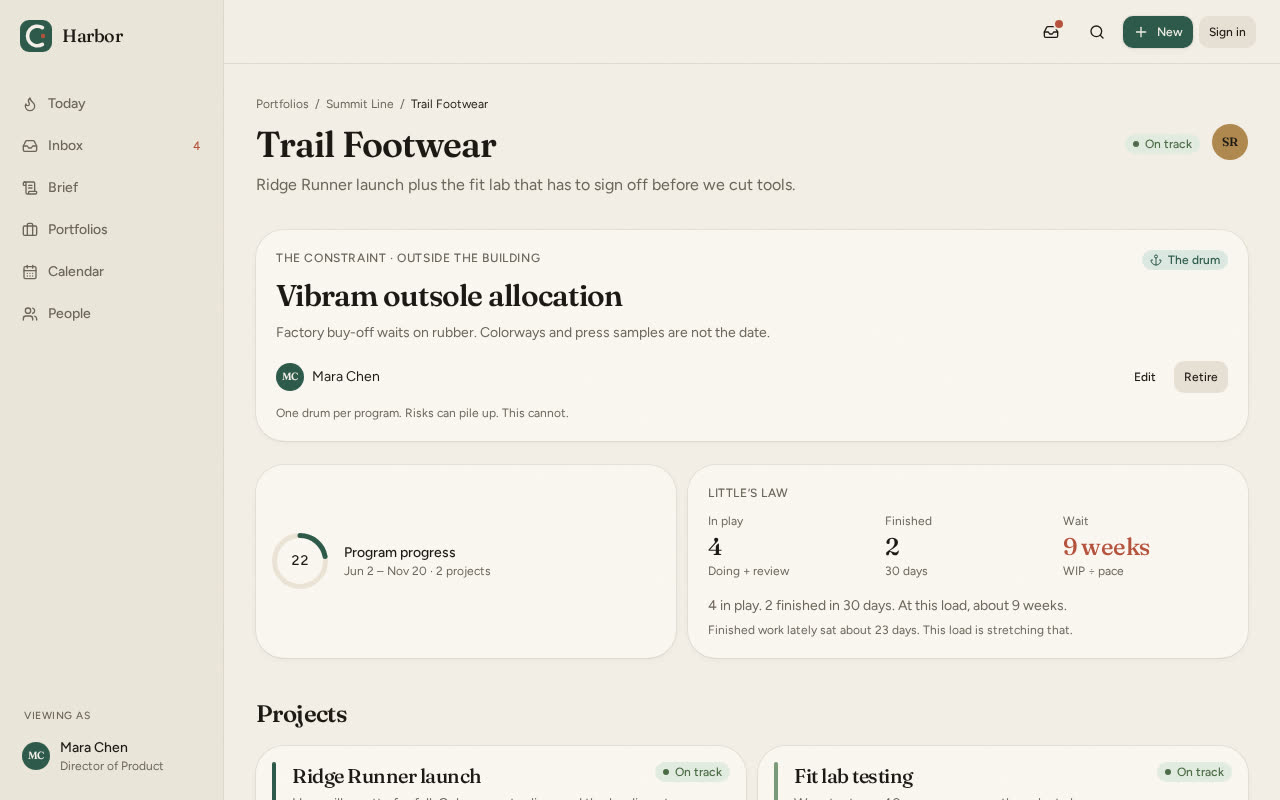
Trail Footwear holds the Ridge Runner launch and the fit lab that must sign off before tooling is cut. The factory says the Vibram outsole rubber lands on the 14th, not the 1st, and buy-off can’t start without it.
It is in the register as Mara’s risk, scored 4 for likelihood and 4 for impact. The mitigation is specific: confirm the October slot in writing and hold 400 pairs of last season’s outsole for press samples. So is the fallback: launch moves to mid-November and samples ship on the old outsole with a note to editors.
The launch was baselined to finish two weeks earlier than it now does. The timeline shows both, so nobody has to remember the original date.
Risks, issues, decisions
One register, three kinds of entry
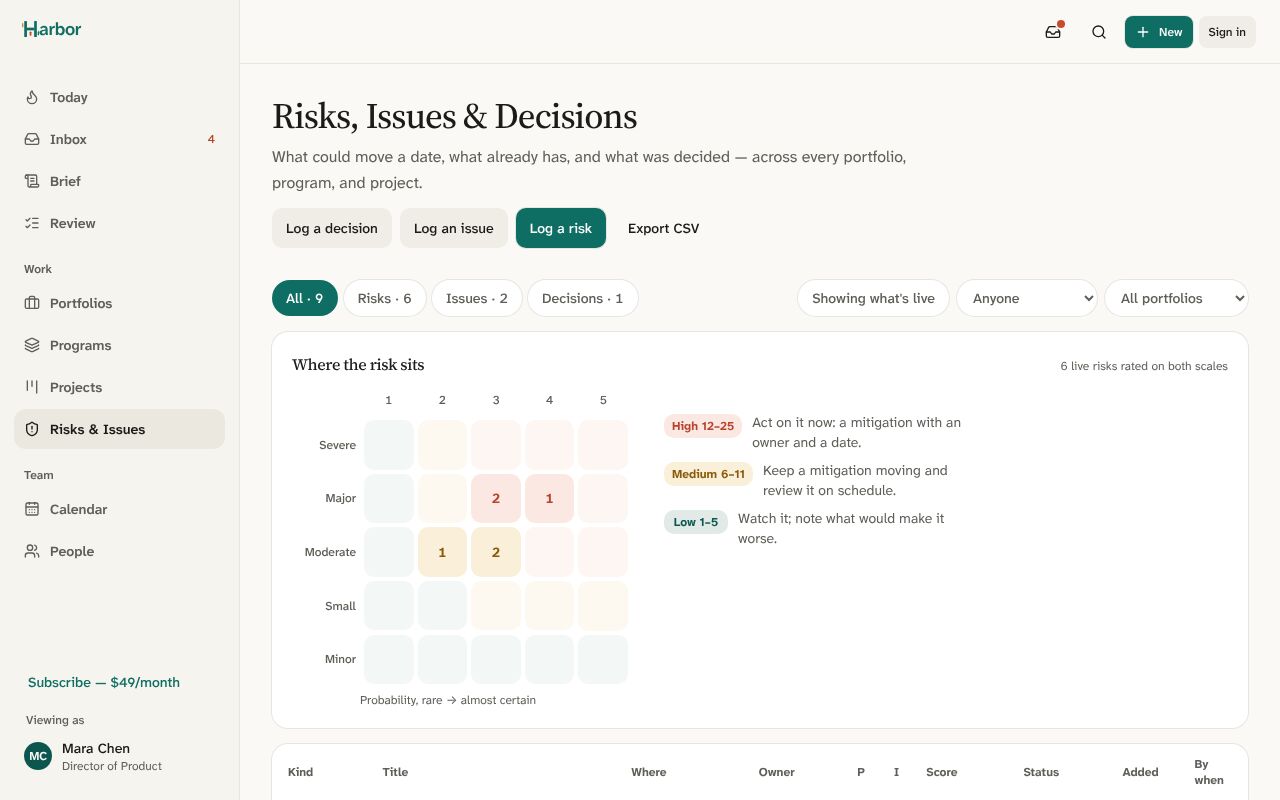
Not everything is a risk. The warehouse’s system upgrade and the store’s inventory cutover land on the same Sunday. That is already happening, so it is logged as an issue, with the fix agreed: the cutover moves a week because the warehouse can’t.
Some entries are decisions. The mill can only hold two colorways in the October run, so Mara decided to ship pine and clay for fall and move the third to spring. The reason is on the record (“two on time beats three late”) and Nico, in brand, replied that he’d pull the third swatch from the lookbook.
A proposed decision sits open too: moving the member app to a single sign-in provider, which the offline maps need. It has an owner and a date, so it can’t quietly drift.
People
Who is carrying what
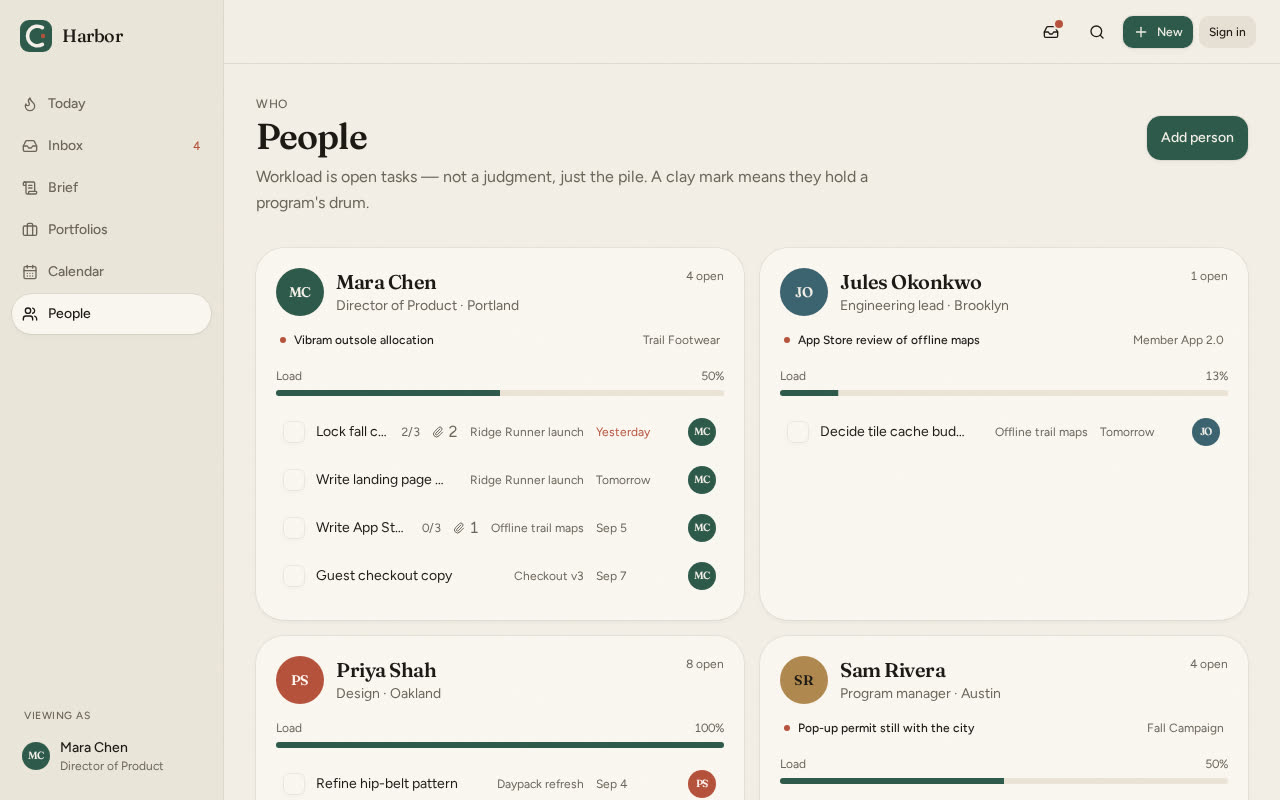
Priya Shah, the designer, holds more open work than anyone, and some of it is late. Jules Okonkwo, the engineering lead, holds the least. Before Mara assigns the next design task she can see it should go somewhere else, or something of Priya’s should move.
Money
Where the budget went
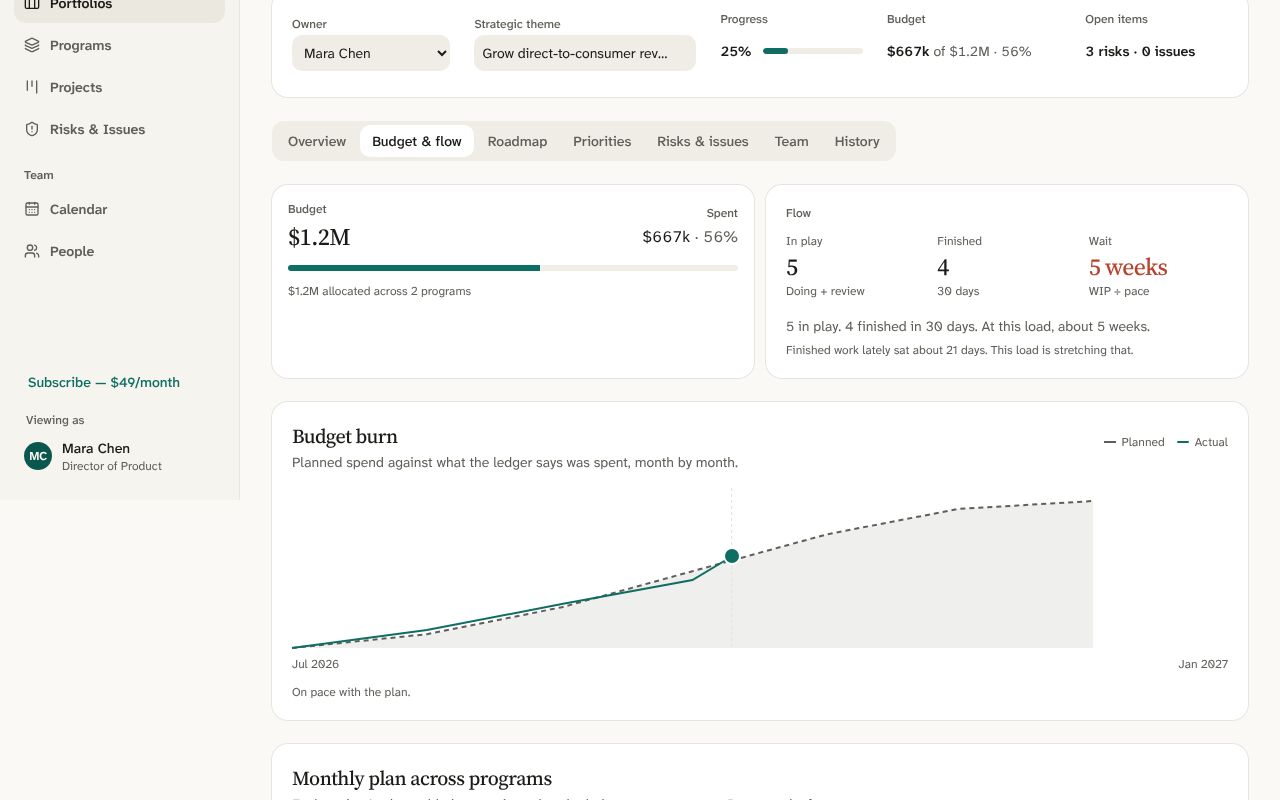
Each portfolio plots planned spend against actual spend, month by month, with a forecast at completion from the pace so far.
The number that matters this week is in Digital Habitat. The navigation redesign has spent $265k of its $310k with about three weeks left. Finance also hasn’t approved the Q4 platform spend that both digital programs assume, so the fallback (do phase one this year, finish next spring) is written down before anyone asks for it.
Friday
The weekly brief
At the end of the week Harbor writes a short letter: what is late, what is at risk, and who owns the next move. Mara sends it instead of holding another status meeting. A one-page status report per program, with budget, milestones and live risks, pastes into the Friday thread.
Milestones that need sign-off wait for her. “Checkout in production” came back with changes requested and a note: “Need a rollback plan documented before I can sign off.”
Your own week
Name a workspace and start with one portfolio and the program that keeps you up at night. Harbor is $49 a month for the workspace, however many people are in it.